
Britain is home to more than 250 species of bee, but you do not need to learn every one before you can make useful identifications. Most garden sightings fall into a smaller set of familiar bumblebees, solitary bees and the western honey bee. The quickest clues are body shape, tail colour, bands, facial hair, nesting behaviour and season.
For reliable UK bee identification, take photographs from several angles rather than trusting one glance. A bee’s abdomen may be hidden by a flower, and worn or faded hair can make similar British bees look almost identical. Use the species below as a practical starting point, then compare several features before deciding.
Start with the type of bee
Bumblebees are generally chunky and densely hairy. Social species live in colonies with a queen and workers, while males appear later in the season. Solitary bees usually have a slimmer or more compact build, and each female normally provisions her own nest. Honey bees are medium-sized, brownish and less fluffy than most bumblebees.
Do not rely on size alone. Queens are larger than workers, males may differ from females, and several species overlap in size. For bumblebees, tail colour and banding are especially useful.
Common bumblebees to recognise
Buff-tailed bumblebee
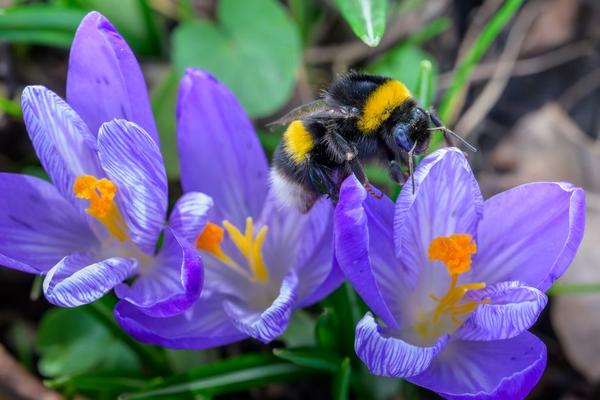
Bombus terrestris is one of the most familiar British species. Queens usually show two yellow-gold bands on a black body and a buff or creamy tail. Workers often have whiter tails, which can make them difficult to separate from white-tailed bumblebees. They occur in gardens, farmland and parks, often nesting underground in old mammal burrows.
White-tailed bumblebee
Bombus lucorum has a similar black-and-yellow pattern but a clean white tail. Queens often have bright lemon-yellow bands. Workers of several closely related white-tailed bumblebees are difficult to distinguish confidently in the field, so a broader identification is better than forcing an exact species when the markings are unclear.
Red-tailed bumblebee
Female Bombus lapidarius are mostly black with a vivid orange-red tail. Males look different, with yellow facial hair and a yellow band near the front of the thorax. This widespread species is often found in gardens, open countryside and urban bee habitats.
Common carder bumblebee
Bombus pascuorum is the familiar ginger-brown bumblebee often seen on garden flowers. Its thorax is usually warm ginger or tan, while the abdomen carries a mixture of pale, brown and darker hairs rather than a sharply contrasting white or red tail. Colour varies considerably between individuals.
Tree bumblebee
Bombus hypnorum has a distinctive ginger-brown thorax, black abdomen and white tail. It commonly uses above-ground cavities such as bird boxes, roof spaces and holes in trees. Males sometimes hover around a nest entrance while waiting for new queens, behaviour that can look dramatic but is a useful identification clue.
Early bumblebee
Bombus pratorum is relatively small, with a red-orange tail and usually one or two yellow bands. It is often noticeable early in the year and becomes less conspicuous later in summer. Its smaller build and yellow banding help separate it from the female red-tailed bumblebee.
Garden bumblebee
Bombus hortorum has a white tail and three yellow bands: two across the thorax and one on the abdomen. Its long face and very long tongue are useful for reaching nectar in deep flowers such as foxgloves and honeysuckle.
Common solitary bees and the honey bee
Red mason bee
Osmia bicornis is common around gardens and buildings in spring and early summer. Females are robust, gingery-brown bees that often nest in existing holes in walls, timber or bee hotels. A female creates individual brood cells, adding pollen and nectar before sealing each one.
Tawny mining bee
Female Andrena fulva are among the easiest solitary bees to recognise, with bright fox-red hair above and darker legs and underside. Look for small soil mounds in lawns, borders and sunny ground. Several nests may sit close together even though each female manages her own burrow.
Hairy-footed flower bee
Anthophora plumipes is a fast spring bee often seen around lungwort and other early blooms. Females are usually dark, while males are paler and have conspicuous long hairs on their middle legs. Their darting, hovering flight can initially suggest a bumblebee.
Western honey bee
Apis mellifera is slimmer than most bumblebees, with a brown to golden-brown abdomen that may show darker bands. Workers carry pollen in baskets on the hind legs and can gather in numbers on rich flower patches. Many British colonies are managed, although swarms and free-living colonies are also encountered.
Use behaviour, habitat and season as supporting clues
Markings should lead the identification, but context can strengthen it. A ginger, black and white bee repeatedly entering a bird box strongly suggests a tree bumblebee. A fox-red female disappearing into a neat hole in a sunny lawn points towards a tawny mining bee. A chunky ginger bee using a tube in a bee hotel in May is more likely to be a red mason bee than a bumblebee.
Season matters too. Queen bumblebees are especially noticeable in spring as they search for nest sites, while many solitary species have shorter flight periods. Weather can shift activity from year to year, so dates are clues rather than rigid rules.
How to make a more reliable identification
Photograph the top, side and rear without disturbing the bee. Note the tail colour, number and position of bands, face shape, leg hairs and whether pollen is being carried. Record the flower, nesting place and month as well. This combination is more dependable than matching one colour patch from a single photograph.
For deeper reading, see our guide to bee life cycles, our guide to bee nesting behaviour, and our guide to creating bee-friendly habitats. These topics help explain why particular species appear in certain places and at certain times of year.
Frequently asked questions
What is the most common bee in Britain?
There is no single species that is most common everywhere. Buff-tailed, white-tailed, red-tailed and common carder bumblebees account for many everyday sightings, while honey bees can be locally abundant near managed colonies.
How can I tell a bumblebee from a solitary bee?
Bumblebees are usually rounder and more densely hairy, but appearance overlaps. Nesting behaviour helps: social bumblebees have colonies with workers, whereas a solitary female generally builds and provisions her own nest.
Why do bees of the same species sometimes look different?
Queens, workers and males may differ in size or markings, while hair can fade or wear with age. Natural colour variation also occurs, so use several identification features together.
Should I catch a bee to identify it?
Usually not for casual identification. Clear photographs plus notes on behaviour, habitat and date are often enough to narrow common species. Difficult groups may require expert examination, and a broader identification is preferable to unnecessary disturbance.
Building confidence with British bee identification
Learning common British bee species becomes easier when you start with a few memorable patterns rather than trying to recognise everything at once. Learn the red-tailed species, the white-tailed group, the ginger common carder, the tree bumblebee’s ginger-black-white combination and the nesting habits of familiar solitary bees. Add season, habitat and behaviour, and a busy flower border soon becomes much easier to read.