
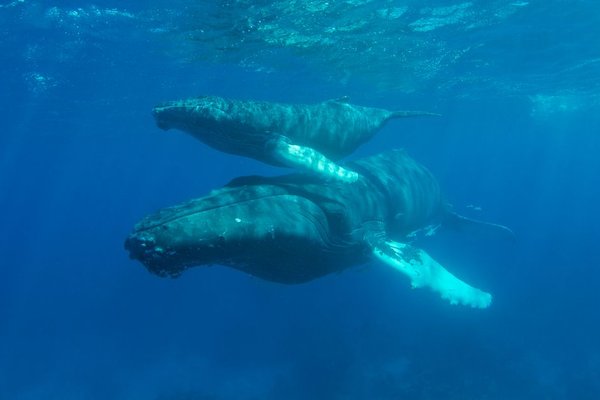
A whale can disappear beneath the surface while its voice continues through the water. A low moan, a burst of clicks or a sharp call may reach another animal nowhere in sight. For whales, sound helps maintain contact, find companions, coordinate behaviour and navigate a world where visibility can vanish within metres.
Understanding how whales communicate means listening beyond their famous songs. Different species use different signals, and the same sound may have several possible functions depending on who makes it, when and where.
Why Sound Matters More Than Sight Underwater
Light fades quickly with depth, and even shallow water can become murky. Sound travels efficiently through the sea at roughly 1,500 metres per second, although its speed changes with temperature, pressure and salinity. That makes underwater sound useful for animals separated by darkness or distance.
How far a call can be heard depends on its frequency, loudness, water conditions and surrounding noise. Low-frequency calls from some baleen whales can travel especially far. In certain ocean layers, sound bends through a natural acoustic channel, allowing signals to travel considerable distances. It does not mean every whale call crosses an ocean.
Whale Songs: Repeated Patterns With a Social Purpose
Humpback whale songs are among the most recognisable examples of cetacean communication. A song contains repeated sound units arranged into phrases and larger themes. A male may sing for extended periods, cycling through a complex sequence rather than producing random noises.
Researchers associate much humpback singing with the breeding season, but the exact purpose remains debated. Songs may influence interactions between males as well as mating behaviour. Describing every song as a direct invitation to females oversimplifies the evidence.
Humpback songs change over time. Whales in the same breeding population often share a broadly similar current version, with modifications spreading through social learning. Whale songs therefore offer a window into animal culture, not merely instinct.
Whale migration patterns can influence when songs are heard.
Short Calls Keep Social Lives Moving
Not every vocalisation is a song. Many whales produce shorter calls, including moans, grunts, pulses and other distinctive sounds. Some are associated with social contact, movement or feeding, although scientists cannot assign a universal translation to each one.
Mother-calf pairs may use contact calls to remain connected. For an animal that must surface to breathe while staying close to a young calf, recognising and locating a companion is a practical necessity.
Clicks, Whistles and Echolocation in Toothed Whales
Toothed whales, including sperm whales, belugas and orcas, use sound differently from many baleen whales. Their repertoires can include whistles, pulsed calls and high-frequency clicks. Some clicks are used for echolocation: the whale emits a sound and processes returning echoes to detect prey or nearby objects.
Echolocation is primarily a way to sense surroundings, not necessarily a message sent to another whale. That distinction is easy to miss when a recording contains rapid clicking. However, some toothed whales also use patterned clicks socially.
Sperm whales, for example, exchange brief rhythmic sequences called codas. The spacing of clicks varies among social groups and can help researchers investigate identity and relationships. Their regular foraging clicks serve a different primary purpose from these social patterns.
Do Whale Groups Have Their Own Dialects?
Some do, in the biological sense of recognisable group-specific vocal traditions. Orca pods in the northeastern Pacific use sets of learned calls that differ between family groups. These repertoires can help maintain group cohesion and signal social identity.
Sperm whale social units also belong to larger vocal clans distinguished partly by their coda repertoires. Such patterns suggest that at least some communication habits are learned and passed through communities.
Calling these systems “languages” is tempting, but researchers have not shown that whales use words and grammar in the human sense. Their communication is sophisticated without needing an imagined translation.
Body Signals Add Another Layer
Whales communicate in ways an underwater microphone cannot fully capture. Tail slaps, pectoral-fin slaps, breaching and changes in body position may carry social information. A forceful slap creates both a visible display and a sound that travels through water.
Context decides what a gesture might signify. A tail slap could occur during agitation, social interaction or feeding-related activity. Likewise, a breach should not automatically be labelled a greeting. Researchers compare repeated behaviours with the whales nearby before interpreting a signal.
For humpbacks feeding together, body movements and vocal activity form part of the broader story of how humpback whales feed, though not every coordinated action has a proven communicative meaning.
A Listening Example: Two Very Different Click Sequences
Imagine a hydrophone recording sperm whales off a Caribbean island. One sequence contains repeated, widely spaced clicks during a deep dive; another captures compact rhythmic codas as whales socialise near one another. Both may sound like clicking to an untrained ear, yet their behavioural contexts point toward different functions.
Researchers examine the timing, dive data and movements of the animals before drawing conclusions. When listening to whale recordings, compare the rhythm and repetition, then check what scientists know about the species and behaviour.
When Human Noise Interrupts the Conversation
The sea is naturally noisy, with wind, waves and other animals producing sound. Shipping, construction and some sonar activities add human-generated noise. When that noise overlaps a whale’s calls, it can mask them, shrinking the area in which another whale can detect the signal.
Researchers call this loss of acoustic reach a reduction in communication space. Its effects vary with species, location and sound type. The wider issue of ocean noise pollution is not that whales suddenly lose their voices, but that communicating and listening may become more difficult when sound matters most.
How Scientists Study Whale Communication
Scientists deploy hydrophones to record underwater sounds and use spectrograms to display their frequencies and timing. Animal-borne tags, observations and photographs help connect those sounds to specific movements or individuals.
A call recorded near feeding whales might serve a different role elsewhere. Researchers look for consistent patterns across many encounters before suggesting a function.
Frequently Asked Questions
Can whales communicate over hundreds of kilometres?
Some powerful, low-frequency whale sounds can be detected across very long distances under favourable ocean conditions. Actual range varies substantially, and detecting a call does not prove another whale responded to it.
Do all whales sing?
No. Many species vocalise, but elaborate, repeated songs are particularly well documented in humpback whales. Other species rely more on calls, whistles or clicks.
Are whale clicks a form of communication?
Sometimes. Toothed whales use many clicks for echolocation, while social patterns such as sperm whale codas are associated with interactions among group members.
Can scientists translate whale sounds?
Not reliably into sentences. Scientists can identify certain call types, social patterns and behavioural associations, but much of the information encoded in whale sounds remains unknown.
The Ocean Is a Network of Voices
Whales communicate through a combination of songs, shorter calls, clicks and body signals. The most revealing question is often not what a sound resembles to us, but who produced it, who could hear it and what happened next. Listening with that context reveals an ocean full of relationships, while reminding us how much of whale social life still lies beyond human hearing.