
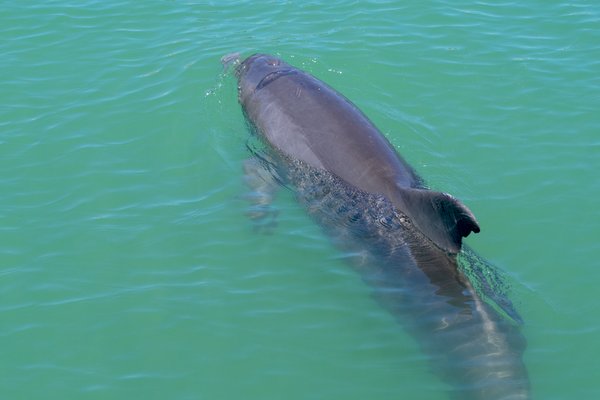
A small dark fin breaks the surface, followed by a rounded back and a quick breath. Then the animal disappears without a splash. That fleeting encounter could be a harbour porpoise, a cetacean easily overlooked in British seas. Unlike dolphins that sometimes bow-ride alongside boats, porpoises usually keep a low profile.
The harbour porpoise (Phocoena phocoena) lives around much of the UK coastline and farther offshore. Its feeding habits and subtle behaviour explain why sightings can be so brief.
How to recognise a harbour porpoise
Harbour porpoises are compact cetaceans, generally around 1.4–1.9 metres long as adults. Their backs are dark grey to brownish-grey, with lighter sides and a pale underside. The head is rounded, without the obvious projecting beak seen on many dolphins. A small, roughly triangular dorsal fin sits on the back.
At sea, body shape matters less than movement. A porpoise typically rolls smoothly through the surface, exposing its back and fin for a moment before diving again. It rarely performs the high, conspicuous leaps associated with some dolphin species. On a calm day, you might hear its short, puffing exhalation before spotting it.
Where harbour porpoises live in UK waters
Harbour porpoise habitat includes shallow coastal seas, bays, straits and continental-shelf waters. They occur in the North Sea, Irish Sea, western Scottish waters and other seas around Britain and Northern Ireland. They are not confined to harbours, despite the name, and can travel well beyond sight of land.
Areas with strong tidal currents can be particularly valuable. Where moving water mixes and concentrates fish, a small predator has opportunities to feed efficiently. Coastal waters off western Wales and Scotland are among the places where porpoises are regularly recorded. The southern North Sea and Bristol Channel Approaches also contain protected areas designated for the species.
Distribution is not static. Sightings vary between seasons, years and locations as prey availability and environmental conditions change. Poor visibility can also conceal animals that are present.
What does a harbour porpoise eat?
The porpoise diet consists mainly of fish, although squid and other suitable prey may also be eaten. Species taken depend on local conditions and availability; small schooling fish such as herring, sprat and sandeels are important in parts of its range. A porpoise may also catch small bottom-associated fish rather than hunting only near the surface.
To find food underwater, it uses echolocation: rapid, high-frequency clicks that produce returning echoes from objects and prey. This biological sonar helps it navigate and hunt even in murky water, where eyesight alone would be unreliable.
Small bodies lose heat quickly in cold seas, so harbour porpoises need frequent feeding. That dependence on accessible prey helps explain why productive tidal channels and fishing grounds can matter so much to their survival. An apparently unremarkable stretch of water may support a busy feeding area beneath the surface.
Everyday porpoise behaviour
Typical porpoise behaviour is discreet. Individuals are often seen alone or in pairs, sometimes in small groups; larger gatherings can occur where food is abundant. They surface briefly to breathe and spend much of their time submerged, which makes counting them from land surprisingly difficult.
They are mammals, not fish. They breathe air, give birth to live young and nurse their calves. In UK waters, births are particularly associated with late spring and summer, although timing varies. A calf accompanying an adult may surface close beside its mother, but observers should never approach to investigate.
Harbour porpoise versus dolphin: the clues that matter
Porpoises and dolphins are both toothed cetaceans, but they belong to different families. Compared with a bottlenose dolphin, a harbour porpoise is usually smaller and stockier, with a blunt face instead of a pronounced beak. Its dorsal fin tends to look shorter and more triangular than the taller, curved fin typical of bottlenose dolphins.
Behaviour provides another clue. Bottlenose dolphins may leap, travel in conspicuous groups and approach boats; harbour porpoises are more likely to slip quietly away. These are tendencies rather than guarantees, so a single distant fin should not be treated as a certain identification. A broader comparison of dolphins in UK waters can help when the view is incomplete.
How to spot a porpoise from shore
Choose a headland overlooking a channel or an area where tides bring fish close to the coast. Early mornings can offer calmer water, although sea conditions matter more than the clock. Bring binoculars, but begin by scanning with your eyes: the first hint is often a tiny triangular fin or a sequence of low, rounded rolls.
For example, on a calm watch along the west Wales coast, fix your gaze on one patch of water for several minutes instead of constantly sweeping the horizon. If a small fin appears, note where it travelled and watch ahead of that point. A porpoise may surface again nearby, though it can change direction underwater.
Record the date, location, sea state, approximate number of animals and your confidence in the identification. Such notes, including sightings submitted to the Sea Watch Foundation, can contribute to knowledge of cetacean distribution. Other small cetaceans found around Britain are also worth learning to recognise.
Threats and protection in British seas
Being widespread does not make harbour porpoises free from danger. Accidental entanglement in fishing nets, known as bycatch, can be fatal. Underwater noise from some human activities may disturb feeding or communication, while persistent pollutants and changes in prey availability present additional conservation concerns.
UK marine protected areas include sites designated because they are important for harbour porpoises. Limiting harmful disturbance, addressing bycatch and maintaining conditions that support prey are central challenges.
Visitors can help by watching from shore where possible. If you are on a boat, do not chase a porpoise, cut across its path or crowd an animal with a calf. Follow recognised wildlife-watching guidance, reduce speed when animals are nearby and allow them to choose their own course.
Frequently asked questions
Are harbour porpoises common in the UK?
Yes. They are among the most widespread cetaceans in UK waters, although their quiet surfacing and changing local distribution mean people can easily miss them.
Can you see harbour porpoises from land?
Yes. Sheltered bays, headlands and tidal channels offer opportunities, especially when the sea is calm enough to reveal a small fin. A patient watch is often more productive than searching from a moving boat.
Do harbour porpoises live in rivers?
They are primarily marine animals but may occasionally enter estuaries or river mouths. A sighting well upstream is unusual and should not be taken as evidence of a resident freshwater population.
How can you tell a porpoise from a dolphin?
Look for a small, stocky body, blunt head, triangular fin and low, quiet surfacing. Dolphins such as bottlenose dolphins usually have a more distinct beak and can behave more conspicuously, but distant sightings remain uncertain.
A quiet presence worth protecting
The harbour porpoise is a reminder that remarkable wildlife does not always announce itself. Its subtle movements, demanding feeding routine and reliance on healthy coastal seas make it an important part of Britain’s marine life. Knowing what to look for turns an easily missed breath at the surface into a meaningful glimpse of the wider underwater ecosystem.