
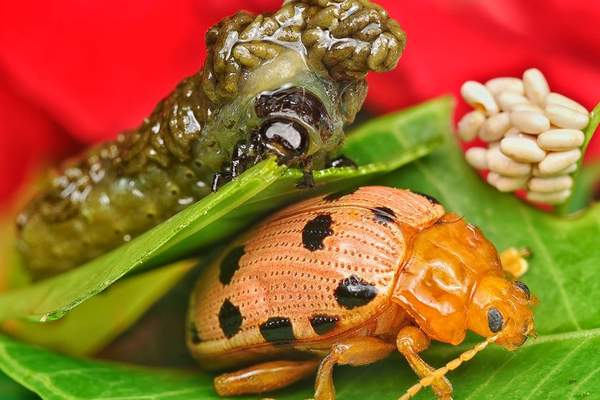
A curled white grub under the lawn and a brightly coloured ladybird on a leaf might seem unrelated. Yet both can represent stages in the same kind of transformation. The beetle life cycle follows four distinct forms: egg, larva, pupa and adult. This pattern, called complete metamorphosis, is shared by beetles from tiny grain pests to large stag beetles.
The sequence stays remarkably consistent across the order Coleoptera, but the timing, habitat and diet can differ dramatically. Understanding what each stage does makes it easier to recognise beetles outdoors, explain the damage some species cause and appreciate the useful work others perform.
How Complete Metamorphosis Works
Unlike insects whose young resemble smaller versions of adults, beetles change body plan during development. A newly hatched larva usually looks nothing like the beetle it will become. It feeds and grows, enters a pupal stage for major internal reorganisation, then emerges as an adult capable of reproduction.
The four beetle development stages have different jobs. Eggs protect the developing embryos. Larvae concentrate on growth and storing energy. Pupae undergo transformation without feeding. Adults disperse, mate and produce the next generation. These roles can overlap slightly between species, particularly when adults also feed actively.
Egg Stage: Starting in the Right Place
After mating, a female beetle deposits eggs where newly hatched young have a reasonable chance of surviving. Depending on the species, that might mean soil near plant roots, a sheltered leaf surface, decaying wood, stored grain or animal remains. Eggs are generally small and easily overlooked, with colour and shape varying between species.
Location matters because many beetle larvae cannot travel far immediately after hatching. A ladybird laying near aphid colonies gives its young access to prey, while a wood-boring beetle places eggs where larvae can enter suitable timber. Egg development depends partly on temperature and moisture; there is no universal hatching time for every beetle.
Larva Stage: The Main Period of Growth
Once an egg hatches, the beetle enters its larval stage. This is often the most intensive feeding period of its life. Some beetle larvae are pale, thick-bodied grubs with curved backs. Others are long, flattened or active hunters with prominent jaws. The familiar mealworm is also a beetle larva, not a true worm.
Because their outer skeleton cannot stretch indefinitely, larvae periodically shed it through moulting. Each period between moults is called an instar. The number of instars differs by species, so describing every beetle as having exactly three larval stages would be misleading.
What Do Beetle Larvae Eat?
Diet depends on the beetle. Scarab grubs may feed on living roots or decomposing organic material. Ladybird larvae hunt aphids and other small insects. Some ground beetle larvae are predators, while wood-boring larvae consume material within trunks or branches. Carpet beetle larvae can feed on animal-derived fibres and other dry organic matter.
This difference explains why the life stage you find often tells you more than the adult’s appearance. A small beetle near a window may be harmless at that moment, while its hidden larvae are responsible for damaged fabrics or food. Conversely, an unfamiliar larva on an aphid-covered plant may be helping to control pests.
Pupa Stage: The Body Is Rebuilt
After reaching sufficient maturity, the larva stops feeding and pupates. Some species form a chamber in the soil, while others pupate inside wood or in another sheltered place. Beetle pupae often show recognisable outlines of developing legs, antennae and wing structures, although these features are not yet functioning as they will in adults.
The pupa may look inactive, but substantial change is taking place inside. Larval tissues are remodelled and adult structures mature. Beetle pupae generally do not eat, relying on resources accumulated earlier. Disturbing one can damage a vulnerable stage, so an exposed pupa is best left undisturbed when possible.
Adult Stage: Dispersal and Reproduction
When development is complete, the adult emerges from the pupal covering, a process known as eclosion. Its outer body covering may need time to harden and develop its final colour. Most familiar adult beetles have hardened front wings called elytra, which protect the delicate flight wings beneath, although some species are flightless.
Adults seek food, shelter and mates according to their species’ habits. Some eat leaves, pollen or other insects; others feed little as adults. Once females lay eggs, the cycle begins again. The adult form is usually the easiest stage to identify, but it is not necessarily the longest-lived stage.
Why Some Beetles Develop Faster Than Others
A useful way to understand the beetle life cycle is to separate the fixed sequence from the variable timetable. Some beetles can complete development in weeks under favourable conditions. Other species, including certain wood-borers and scarabs, spend years developing, especially as larvae.
Temperature influences growth because beetles are cold-blooded animals. Food quality, moisture, seasonal conditions and species biology also matter. In colder climates, some grubs spend winter inactive in soil and resume feeding when conditions improve. A beetle population may therefore produce several generations in one year or take multiple years to complete one.
A Practical Example in the Garden
Suppose you uncover a C-shaped grub while planting. Its pale body, brownish head and short legs may suggest a scarab beetle larva, but appearance alone rarely identifies the exact species. Rather than assuming it is a harmful pest, note where it was found, whether plant roots show damage and whether other grubs are present. Different beetles have very different ecological roles.
For a closer look at harmless wildlife, observe larvae on leaves without removing them. Ladybird larvae, for example, are elongated and often dark with contrasting markings; they do not look like miniature spotted adults. Watching one feed and later pupate makes complete metamorphosis much easier to understand.
Common Questions About Beetle Development
Do All Beetles Have Four Life Stages?
Yes. Beetles undergo complete metamorphosis through egg, larva, pupa and adult stages. Their appearances, development times and habitats vary, but the basic sequence defines their development.
How Long Does a Beetle Life Cycle Take?
There is no single duration. Certain species complete development in a matter of weeks, while others take a year or several years. Temperature, food and the particular species influence the timetable.
Is a Grub the Same as a Beetle Larva?
Grub is a common name for many beetle larvae, especially the thick, curled larvae of scarab beetles. Not all beetle larvae have that shape; some are slender, flattened or active predators.
Can Beetle Pupae Eat or Move?
Beetle pupae generally do not feed. Some can make limited movements, but they are not active hunters or foragers. Their main function is to complete the transformation into adults.
Final Thoughts
From a hidden egg to a hungry larva, a transforming pupa and a reproductive adult, each stage has a distinct purpose. Recognising that pattern helps explain why the same beetle species can look completely different at different ages. The next time you find an unfamiliar grub or pupal case, consider where it fits in this four-stage story before deciding what it is.