
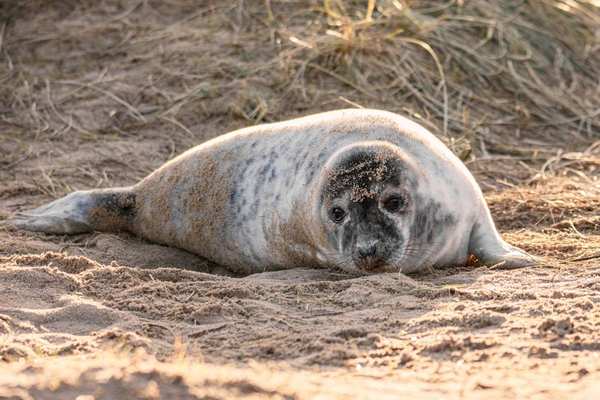
A grey seal surfacing beside a rocky headland may appear for only seconds, yet its life connects an extraordinary stretch of British coast. These marine mammals hunt offshore, rest on secluded shores and return to familiar breeding places each year. Grey seals in the UK are among the most recognisable sights in British coastal wildlife, but there is far more to them than curious faces and fluffy pups.
From Scotland’s remote islands to Norfolk’s viewing beaches, their story explains why quiet coastline and healthy seas belong together.
How to recognise a grey seal
The grey seal, Halichoerus grypus, is the larger of the UK’s two resident seal species. Big males can reach roughly 2.5 metres and weigh around 300 kilograms, although females are smaller. Coat colours range from pale silver to nearly black, often with distinctive spots.
Look at the head rather than the colour. A grey seal has a long, relatively straight or convex muzzle, particularly pronounced in adult males. The smaller harbour seal, also called the common seal, has a rounder, dog-like face. Both lack visible external ear flaps. At a distance, binoculars are more useful than trying to judge size.
Where do grey seals live in Britain?
Grey seals inhabit much of the UK coastline, with major breeding colonies around the Hebrides, Orkney, the Isle of May and the Farne Islands. They also breed around Pembrokeshire, the Isles of Scilly and eastern England, including Donna Nook in Lincolnshire and the Norfolk coast.
These places look different. Some colonies occupy remote islands and rocky coves; others use beaches, dunes and saltmarshes. A seal resting at one site may travel far to feed, so a colony’s visible shoreline represents only part of its territory.
Grey seal habitat: two connected worlds
Safe places to come ashore
When seals leave the water, scientists say they are hauling out. Beaches, tidal rocks, sheltered bays, caves and islands provide places to rest, moult and give birth. A shore that seems empty to visitors may be valuable precisely because it is difficult to reach.
Feeding grounds beneath the waves
At sea, grey seals often search for prey close to the seabed, although they also hunt higher in the water. Their habitat includes coastal shallows and deeper offshore feeding areas. Some spend days away from familiar resting sites. Protecting grey seal habitat therefore means thinking about both quiet shores and productive seas.
What do grey seals eat?
The grey seal diet is dominated by fish, but it varies by region and season. Sand eels, cod, whiting, haddock and flatfish such as plaice can all feature. Grey seals also take other marine animals, including squid and crustaceans.
These are skilled underwater hunters. Sensitive whiskers help detect movement in the water, while streamlined bodies, strong flippers and oxygen-storing adaptations support repeated dives. Most feeding dives are considerably shallower than the species’ deepest recorded dives.
Breeding, white pups and the changing seasons
Grey seals generally give birth to one pup each year. Timing varies across Britain: births can begin in late summer or early autumn on western coasts, while colonies in eastern England may have pups from October into January. There is no single UK-wide pupping month.
Newborns have thick white fur and spend their earliest weeks on land. Mothers nurse them on rich milk for about two to three weeks, allowing rapid weight gain. Pups then shed their white coat, develop sleeker fur and eventually enter the sea. A newly weaned pup may remain alone on a beach without being abandoned.
Breeding colonies can be crowded and noisy. Females attend their pups, while males may compete for mates. An unexpected approach by people or dogs can cause serious disturbance. If adults flee into the water, pups may be injured or separated.
Life beyond the breeding season
Grey seals do not disappear when the pups leave. They forage, rest offshore, return to haul-out sites and shed old fur during an annual moult. At sea, a seal may float almost vertically with its head above water, a resting posture called bottling.
A group stretched across rocks is not necessarily a permanent family. Individuals gather at convenient sites while spending much of their time apart at sea. Observing these changing patterns reveals a quieter side of coastal life.
Where and how to watch grey seals responsibly
The Farne Islands offer boat-based views around rocky shores, while Horsey in Norfolk and Donna Nook have popular seasonal land-based viewing areas. In Pembrokeshire, seals can appear around isolated coves. Access may change during pupping, so check local reserve guidance before travelling.
Imagine visiting Norfolk in November. Instead of approaching a white pup for a photograph, stay behind designated barriers, use binoculars and watch from afar. A pup lying quietly is not automatically in trouble. If one looks injured or genuinely distressed, contact a wildlife rescue organisation rather than moving it yourself.
As a precaution, stay at least 100 metres away where possible, keep dogs back and never feed or touch a seal. If an animal repeatedly looks towards you or heads for the water, retreat. Learning about seabirds of the British coast can enrich the same trip without disturbing either group.
Conservation along the British coast
Grey seals have recovered in parts of Britain, but still face risks. Entanglement in fishing gear, marine litter, disturbance at breeding sites and changes in prey availability can harm them. Storms and changing coastal conditions may add pressure to sensitive colonies.
Marine protection and well-managed wildlife tourism help, especially when they consider both breeding beaches and offshore feeding grounds. A thriving colony is not permission to approach closely. Giving seals space remains one of the simplest contributions visitors can make.
Frequently asked questions
Are grey seals common in the UK?
Yes. Grey seals are widespread around British coasts, and the UK supports a substantial share of the global population. They are easiest to spot near established resting and breeding sites.
How are grey seals different from common seals?
Grey seals are generally larger with longer, more pronounced muzzles. Common or harbour seals have rounder heads and shorter, dog-like faces. Their typical pupping seasons differ too.
When is the best time to see grey seal pups?
It depends on location. Many western colonies begin pupping earlier in autumn, while some eastern English colonies have pups into winter. Check local reserve timetables and closures.
Do grey seals live in the sea all year?
They spend much of their lives at sea but regularly come ashore to rest, moult and breed. Both environments are essential to survival.
A familiar face with a wide-ranging life
Grey seals connect sheltered places where pups begin life with waters where adults hunt. Seeing a head break the surface offers only a glimpse of that story. Understanding their habitat, diet and seasonal behaviour makes every encounter more rewarding—and shows why watching respectfully matters.