
The quickest way to recognise common British birds is not to memorise every feather. Start with where a bird is, how it moves and the shape of its body. A small bird hopping beneath a hedge offers different clues from one hanging upside down on a feeder. Once you notice those details, familiar visitors become easier to tell apart.
This guide focuses on British bird species found in gardens, parks, woodland edges and streets, including lookalikes that regularly catch beginners out.
Start with three clues before checking colour
First, compare size with a robin, blackbird or woodpigeon. Next, watch the silhouette. Is the body round, the tail long, or the beak short and thick? Finally, note the behaviour. A bird walking across a lawn may be searching for worms; one moving through twigs might be hunting insects.
Light distorts colours, and females and young birds often look different from adult males. Treat a striking marking as supporting evidence rather than the whole identification. Listening helps too: learn a few regular calls instead of attempting every song at once.
Small, familiar birds in gardens and parks
Robin
The robin is compact and round-bodied, with an orange-red face and breast bordered by greyish feathers. Adults often perch openly and investigate freshly disturbed soil. Their thin beak suits insects and other invertebrates. Both sexes look similar, but young robins are mottled brown rather than red-breasted. You may hear their musical song even in winter.
Blackbird
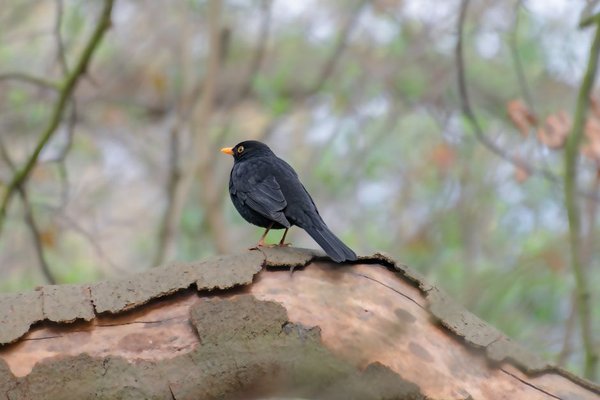
A male blackbird is mostly black, with a yellow-orange bill and yellow eye-ring. Females are brown, usually with a darker bill and subtle breast streaking. Watch for a bird hopping across grass, stopping to listen before probing for food. Its rich, fluting song is familiar from rooftops and trees, especially in spring.
Blue tit
Blue tits are tiny, lively birds with blue caps and wings, white cheeks, a dark eye-stripe and yellow underparts. They often feed acrobatically, clinging to branches or hanging from feeders. Their movements can make identification difficult, so wait for a pause and look for the blue crown. Their calls include high notes followed by a brief rattling trill.
Great tit
Larger than a blue tit, the great tit has a black head, white cheeks, greenish back and yellow belly divided by a bold black stripe. The stripe is particularly useful when both species visit the same feeder. Its repeated two-note song is often described as “teacher, teacher”, although this bird has many variations.
House sparrow
House sparrows are stocky, social birds with sturdy seed-eating beaks. Males have a grey crown, chestnut sides to the head and a black bib. Females are plainer buff-brown, with a pale stripe behind the eye. Look for noisy groups chattering in hedges or around buildings. Unlike a dunnock, a sparrow has a noticeably thicker bill.
Dunnock
Sometimes called a hedge sparrow, the dunnock is not a true sparrow. It has a slim insect-eating beak, greyish head and breast, and brown streaked back. It tends to move quietly beneath shrubs, close to cover. When a small brown bird is alone on the ground rather than chattering in a flock, check for a dunnock.
Wren
The wren is a tiny brown bird with fine barring, a pointed bill and a short tail frequently held upright. It darts through tangled vegetation and disappears almost instantly. Despite its size, its song is astonishingly loud. The upright tail and restless movements are better clues than its fairly plain colour.
Colourful visitors and birds that change appearance
Goldfinch
An adult goldfinch has a red face, black-and-white head and vivid yellow wing flashes. Its fine, pointed beak takes seeds from plants including thistles and teasels. Flocks make light, tinkling calls in flight. Young goldfinches lack the adult red face, but the bright yellow wing pattern can still give them away.
Chaffinch
Male chaffinches have a blue-grey crown, pinkish breast and chestnut back. Females are subtler, in brown and buff. Both show conspicuous white wing bars, particularly when flying. You may spot them feeding on the ground beneath trees or feeders. If you see a muted, sparrow-sized bird, check for those white wing markings.
Starling
From a distance, starlings look simply dark. Up close, adults show glossy green and purple tones, with pale speckles especially prominent in winter plumage. Their pointed bills and purposeful walking help separate them from blackbirds. Young starlings are grey-brown, and their whistles, clicks and imitations sound remarkably varied. Large flocks sometimes gather before roosting.
Larger birds you can recognise at a glance
Woodpigeon
The woodpigeon is a substantial, round-bodied pigeon with a small head, pinkish breast and broad white wing bands visible in flight. Adults have white patches on the neck. It often feeds on lawns and makes a rhythmic cooing call. Do not confuse it with a slimmer collared dove, which is pale grey-buff with a narrow black neck collar.
Magpie
Magpies have black-and-white plumage, a very long tail and iridescent blue-green highlights in good light. Their harsh chattering call often announces them first. In flight, rounded wings and an elongated tail create a distinctive outline. They are adaptable birds in Britain, searching trees, grass and urban spaces for food.
Try a five-minute identification exercise
Choose a window or park bench and watch one patch of ground, hedge and nearby tree. Record each visitor’s approximate size, beak shape, movement and strongest marking before guessing its name. For example, a brown bird slipping under a hedge with a thin bill suggests dunnock; a chunkier brown bird joining a noisy group points towards house sparrow.
Repeat the exercise in different seasons. Spring brings more song, while autumn and winter reveal roaming flocks and plumage changes. Young birds can be particularly confusing, so consider age as well as species. For further practice, explore guides to British bird calls, garden bird nesting habits and seasonal bird migration.
Frequently asked questions
What are the most common UK birds seen in gardens?
Robins, blackbirds, blue tits, great tits, house sparrows, woodpigeons and starlings are among the familiar British birds seen in many gardens. The mix varies with habitat, region, season and available food or shelter.
How do I identify a small brown British bird?
Check beak and behaviour first. House sparrows have thick bills and gather noisily; dunnocks have fine bills and move discreetly beneath shrubs; wrens are tiny, usually with cocked tails. Colour alone is rarely enough.
Do male and female birds always look alike?
No. Male blackbirds are black while females are brown, and male chaffinches are more colourful than females. Robin and blue tit sexes look more similar. Juvenile plumage can differ from both adult forms.
Which bird features are easiest to learn first?
Begin with body size, tail shape, bill thickness and where the bird feeds. Add one memorable feature per species, such as the great tit’s black belly stripe or the goldfinch’s yellow wing flash.
Conclusion
Recognising common British birds becomes easier when you connect appearance with behaviour rather than relying on colour alone. Learn a handful of regular visitors, notice those you cannot immediately name, and revisit the same places throughout the year. Repeated encounters turn an unfamiliar shape or call into a confident identification.