
An eight-legged visitor in the bath is rarely the same spider as the one suspended between your roses. Britain has more than 650 recorded spider species, but a manageable number account for everyday sightings. The quickest way to recognise them is to consider habitat, web shape and behaviour before relying on colour. Some wait in spiral traps; others chase prey across walls or patrol the ground. This guide introduces common UK spider species and the habits that distinguish them.
How to identify a British spider
For practical UK spider identification, check several clues together. Measure the body separately from the legs when possible. Markings vary with age, sex and lighting, so a single photograph may mislead.
A circular web in a hedge suggests an orb-weaver; a silk sheet leading into a crevice points towards a house spider. A small spider jumping across sunny bricks hunts differently. Never pick up an unfamiliar spider just to inspect it.
Common spiders in houses and outbuildings
House spiders (Tegenaria and Eratigena species)
These brown, long-legged spiders often have pale, herringbone-like abdominal markings. They build flat silk sheets with funnel-shaped retreats in sheds, garages and quiet corners, rather than circular webs. Large spiders crossing floors in late summer and autumn are frequently males searching for females, not evidence of an invasion. Closely related species look alike, making exact identification difficult from photographs.
Cellar spider (Pholcus phalangioides)
Also called the daddy-long-legs spider, this indoor resident has a tiny greyish body and remarkably thin, elongated legs. It hangs in a loose, untidy web near ceilings and windows. Disturb the web and it may shake rapidly. Despite its fragile appearance, the cellar spider captures insects and sometimes other spiders.
Noble false widow (Steatoda nobilis)
The noble false widow has a glossy, rounded brown abdomen, sometimes with pale cream markings, and reddish-brown legs. It favours sheltered building exteriors, conservatories and window frames, where its web forms an irregular tangle. Markings may fade on mature females. False widows can bite when trapped against skin, but serious reactions are uncommon; avoid handling them.
Lace-web spiders (Amaurobius species)
Lace-web spiders occupy cracks in walls, fence posts and sheds. Their stockier bodies and hairy, matt abdomens help distinguish them from glossy false widows. Look for messy, woolly-looking silk radiating from a hiding place. A spider waiting beside that retreat offers a stronger clue than a blurry photograph of its markings.
Common spiders in gardens and on outdoor walls
Garden spider (Araneus diadematus)
The classic garden spider is an orb-weaver whose rounded, brown or orange-brown abdomen often carries a pale cross. Its circular web stretches between shrubs, railings or tall plants. The spider waits for vibrations when an insect strikes the sticky spiral. Females are usually much larger than males, especially towards autumn. Cross-shaped markings are helpful, although their brightness varies.
Missing-sector orb-weaver (Zygiella x-notata)
Check window frames and outdoor lights for a wheel-shaped web with a wedge apparently missing. That gap gives this common species its name. A signal thread connects the web to a hiding place. Its silvery patterned abdomen can resemble those of other spiders, but the incomplete orb web is distinctive.
Zebra jumping spider (Salticus scenicus)
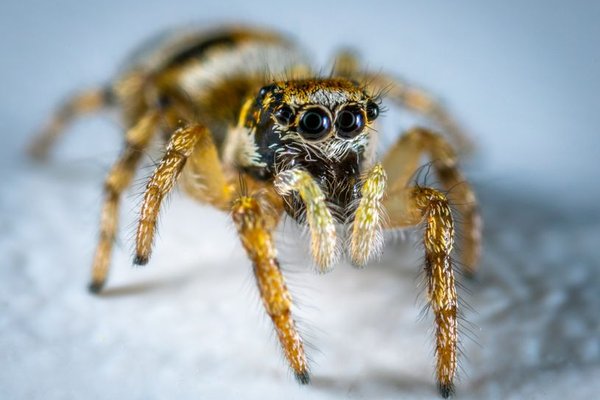
Compact and striped black and white, zebra jumping spiders are seen on sunlit brickwork, fences and windowsills. Their prominent forward-facing eyes and sudden jumps are memorable. Instead of making prey-catching webs, they stalk small insects and leap at close range, trailing a safety line of silk. Watching one hunt is an excellent identification clue.
Wolf spiders (family Lycosidae)
Wolf spiders run across lawns, paths and low vegetation. Usually brown or grey, their mottled stripes provide camouflage. They do not build capture webs. Some females carry round egg sacs attached behind their bodies, then transport newly hatched young on their backs. Britain has many species, several of which require expert examination to distinguish.
Nursery-web spider (Pisaura mirabilis)
Look for a slender brown spider resting on vegetation with its front legs held together. The female carries an egg sac in her jaws, then builds a silken nursery and guards the developing young. Unlike an orb-weaver, this spider hunts without a circular trap. It is found around grassy vegetation, hedgerows and borders.
Woodlouse spider (Dysdera crocata)
A reddish front body, orange-red legs and pale greyish abdomen give this spider a striking two-tone appearance. It shelters under stones, logs and pots, emerging mostly at night to hunt woodlice and other invertebrates. Its prominent jaws are another clue. Leave it beneath its shelter rather than handling it.
Money spiders (family Linyphiidae)
Money spiders are tiny and varied, making precise identification difficult without magnification. Many build delicate horizontal sheet webs in grass and shrubs. Others travel through the air on silk threads, a dispersal method called ballooning. The name refers to a large family, not one species; a small dark spider cannot always be identified more precisely.
What spider webs and behaviour reveal
Try inspecting the same fence, hedge and shed doorway on two mornings. Note which webs remain, which appear overnight and whether their owners wait at the centre or inside retreats. Photograph the whole web before zooming in on the spider. This context makes identification easier than colour alone.
Spiral orbs, funnels and tangled webs reveal different prey-catching strategies. Explore spider web types and how spiders build webs for more detail. Ground-running wolf spiders and jumping spiders use active hunting instead; how spiders hunt and catch prey explains that contrast.
Season offers another clue. Adult male house spiders become more visible during autumn mating activity, while garden orb-weavers stand out as females grow. Egg sacs and guarded young tell further stories; the spider life cycle follows these changes from hatching to maturity.
Frequently asked questions
What is the most common spider in UK gardens?
There is no single answer for every garden. The garden spider is among the most familiar orb-weavers, while money spiders and wolf spiders can be abundant in suitable spider habitats.
Are common British spiders dangerous?
Most pose little risk to people. Bites are uncommon and usually occur when a spider is trapped or handled. Seek medical advice for severe symptoms or a worrying reaction.
Why do large spiders appear indoors in autumn?
Adult male house spiders roam in search of mates during late summer and autumn, increasing sightings on floors and in baths. More sightings do not necessarily mean more spiders have hatched indoors.
Can a spider be identified from its web alone?
Web design narrows the possibilities but rarely guarantees a species identification. Combine the web with body shape, habitat, spider habits and a clear photograph.
Getting to know the spiders around you
You need not memorise every name. Learn a few familiar shapes and behaviours, then record where and when you see them. Once you recognise an orb web, a funnel retreat or a jumping hunter, the variety of British spiders becomes easier to appreciate.