
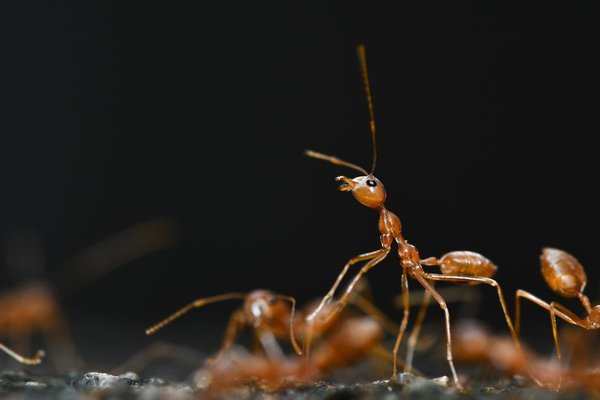
Follow a trail of ants across a garden path and the movement can look chaotic. One ant carries a crumb, another turns back towards the nest, and several disappear underground. Yet each journey contributes to a remarkably organised society. Ant colony structure depends on different groups of ants performing different jobs, sharing information and responding to the colony’s changing needs.
The familiar picture of a queen commanding her subjects is misleading. A colony has no manager issuing instructions. Its organisation emerges from reproduction, division of labour and countless local interactions between individuals.
The three main groups in an ant colony
Most ant societies contain reproductive females, workers and, at certain times, males. These groups form the basic ant caste system, although their numbers, appearance and behaviour vary enormously between species.
Queen ants: the reproductive foundation
A queen’s principal role is laying eggs. In many species, a newly mated queen establishes a nest and produces the first generation of workers. She may initially care for those young herself, but once workers mature, they take over feeding, cleaning and nest maintenance.
Queen ants are not necessarily the colony’s largest individuals, nor do they direct every activity. Some species have one reproductive queen; others maintain several. Queens often live much longer than workers, but lifespan depends on the species and conditions.
Worker ants: the colony’s workforce
Most ants seen gathering food or patrolling a nest are workers. They are female and generally do not reproduce. Their collective duties include finding food, feeding larvae, maintaining tunnels, removing waste and responding to threats.
Some species have similarly sized workers, while others have distinct sizes or forms. In certain colonies, large-headed workers are especially effective at defence or processing difficult food. Calling every large worker a soldier, however, would oversimplify the diversity of ant biology.
Male ants: a specialised reproductive role
Male ants usually appear when a mature colony produces a reproductive generation. Their main biological function is mating with new queens, often during dispersal flights. They generally do not forage, nurse larvae or build nests, and many live only a relatively short time as adults.
In the common reproductive pattern, fertilised eggs develop into females and unfertilised eggs into males. The details can differ between species, so the arrangement is a useful starting point rather than a rule for every ant.
How workers divide the daily jobs
Understanding ant colony roles means looking beyond caste labels. Workers can specialise by age, size, experience or immediate circumstances. A worker’s job is often flexible rather than fixed for life.
Brood care and food distribution
Inside the nest, workers tend eggs, larvae and pupae. They move developing young to suitable chambers, clean them and provide food. Larvae cannot simply leave to find their own meals, so this care is essential to producing the colony’s next generation.
Workers also share food with nestmates in many species, sometimes by exchanging liquid food mouth-to-mouth. This helps resources reach individuals that remain deep inside the nest.
Foraging, defence and housekeeping
Foragers search for seeds, insects, nectar or other resources, depending on the species. Defenders react to disturbances near entrances or valuable food. Other workers excavate chambers, move debris and isolate waste, helping maintain a usable nest environment.
In many species, younger workers spend more time on indoor duties while older workers forage outside, where the risks are greater. Researchers call this age-related division of labour. It is a tendency, not a universal rule: workers can change tasks when the colony needs them, and some species do not follow the pattern.
Who coordinates a colony without a leader?
Much of a colony’s coordination happens through chemical signals called pheromones. Depending on the species and situation, these signals may help mark a food trail, raise an alarm or convey information about reproductive status. Ants also use touch, antennal contact and environmental cues.
Imagine a worker discovering spilled sugar near a pavement crack. In a trail-following species, it may lay a chemical route on the return journey. Nestmates that follow and find the food can reinforce the trail, attracting more workers. When the food disappears, reinforcement stops and the trail weakens. No queen needs to direct the operation.
Not every species uses conspicuous trails, and a strong trail does not mean every ant knows the overall plan. Collective organisation arises because individuals respond to information close to them. This is why a colony is sometimes described as a superorganism: its coordinated behaviour resembles a larger functioning unit.
For more on this process, explore how ants communicate and why ants follow scent trails.
How a colony grows and changes
Many colonies begin when a newly mated queen finds a suitable nesting place and lays eggs. After those eggs develop through larval and pupal stages into adult workers, the workers begin gathering resources. As numbers rise, the nest may gain additional chambers and the workforce can cover more demanding tasks.
A mature colony may eventually invest in new reproductive males and females. These individuals disperse and mate, potentially founding further colonies. Some species instead expand through budding, when queens and workers leave together to establish another nest.
Why two ant colonies may look completely different
A small colony nesting in a twig and a vast network of ants occupying several connected nests are both ant societies, but their organisation differs. Species vary in queen numbers, worker sizes, nesting habits, diet and tolerance of neighbouring colonies.
Leafcutter ants, for example, have workers involved in collecting leaves and cultivating the fungus they eat. Other ants rely more heavily on scavenging or hunting. Those food sources shape which tasks are needed and where workers spend their time.
To understand the workers you see outdoors, it helps to recognise the stages of the ant life cycle as well as the species involved.
Frequently asked questions
Does every ant colony have one queen?
No. Some species or colonies have a single queen, while others contain several reproductive queens. The number may also change during a colony’s development.
Are all worker ants female?
Yes, in the usual ant caste system workers are female. They perform most of the colony’s maintenance and food-gathering work, while males are primarily associated with reproduction.
Do queen ants tell workers what to do?
No. The queen mainly reproduces. Worker behaviour is coordinated through local signals, interactions and changing conditions rather than orders from a central leader.
Can an ant change its job?
Often, yes. A worker may switch between nursing, nest maintenance and foraging as it ages or as colony demands change. The degree of flexibility varies between species.
The colony works because the roles work together
The most revealing feature of ant colony structure is not the queen’s size or the number of workers. It is the way reproduction, brood care, food gathering, defence and communication fit together. Each ant responds to a limited part of its surroundings, yet those individual actions help sustain an entire colony.